|
Special: 11 Places in Europe Where I Wouldn’t Buy a House Today 🇮🇹🇬🇷🇪🇸🇭🇷🇵🇹
Twice a week I send you cheap houses. This is the other half of the job.
|

| |||||||||||||||


Twice a week I put eleven houses in your inbox, most of them under €100,000. A stone cottage in Abruzzo. A village house in the Peloponnese. A farmhouse in Galicia with a roof that needs everything.
And every week I get the same question in some form: what’s wrong with it?
Fair question. Because here is the thing I’ve learned doing this for three years: in Europe, a house is almost never cheap for a boring reason. Sometimes the reason is harmless - the village is far from an airport, the region never got fashionable, the heirs live in Milan and want it gone. Those are the good ones. Those are the ones I send you.
But sometimes the reason is that the last big fire came within two kilometres. Sometimes it’s that the aquifer under the valley is being pumped faster than it refills. Sometimes it’s that the ground itself has risen more than a metre and a half since the 1950s and nobody can tell you when it will stop.
I found this out the hard way. When my family bought our house in Greece, I did what everyone does: hired a lawyer, hired an engineer, signed. The lawyer checked the title. The engineer checked the walls. Between them, they covered the paper and the building.
Nobody checked the place.
Nobody told me how far the nearest emergency department was, whether the village had lost half its population since 1990, what the fire history looked like within five kilometres, or whether the insurance market in that country would even write a policy for the risks I was taking on. I found all of that out afterwards, mostly by accident, occasionally with a cold feeling in my stomach.
So I built the thing I wish I’d had.
11 Risks: the report I wish somebody had sold me
Over the past year I’ve been writing a methodology called 11 Risks. It’s a standardised location “due diligence” report: you give me a property location, and you get back an honest assessment of that place across eleven risk categories, built entirely from public data.
It sits in a gap that I’m fairly confident nobody else in Europe is filling for private buyers. On one side you have lawyers, who do title, contract and building legality - and typically none of what follows. On the other side you have enterprise climate-risk platforms like Climate X, Jupiter and XDI, which are excellent and sold to banks and insurers, not to a couple looking at a house in Puglia. The American consumer products - First Street, ClimateCheck - don’t cover Europe at all.
The report answers questions your lawyer will not: Has it burned here? Has it flooded here, and is the property in a mapped zone? What can the ground do - shake, slide, sink, erupt? Will there be water in the tap in 2040? Will this village still have a shop and a school in fifteen years? How far is the nearest emergency department, honestly, in driving minutes? Are there structural barriers to insuring any of it? And what does this location look like if Europe’s security situation gets worse?
The tagline is Know the risks before you buy, and the positioning line I keep coming back to is: we check the things your lawyer won’t.
 |
I want to be blunt about what it is and isn’t, because I’d rather lose a sale than oversell this. It is a screening report. It is not legal due diligence, not a structural survey, not a valuation, and not investment advice. It won’t tell you whether the extension was built legally or whether the beam in the roof is rotten - go pay a lawyer and a surveyor for those, always. What it does is stop you from falling in love with a house in a place that is going to disappoint you in ways that no contract can fix.
Great news for 11 Houses subscribers - if you have an annual subscription, you get 1 report for free! Just enter the same email address you use for your 11 Houses subscription when placing your order, and the price will be deducted.
The method, in short - Eleven risk categories, in three groups.
I’m going to keep this deliberately brief, because the methodology document is the actual product and I’m not publishing the recipe. But you should know the shape of it, because the rest of this issue is built on it.
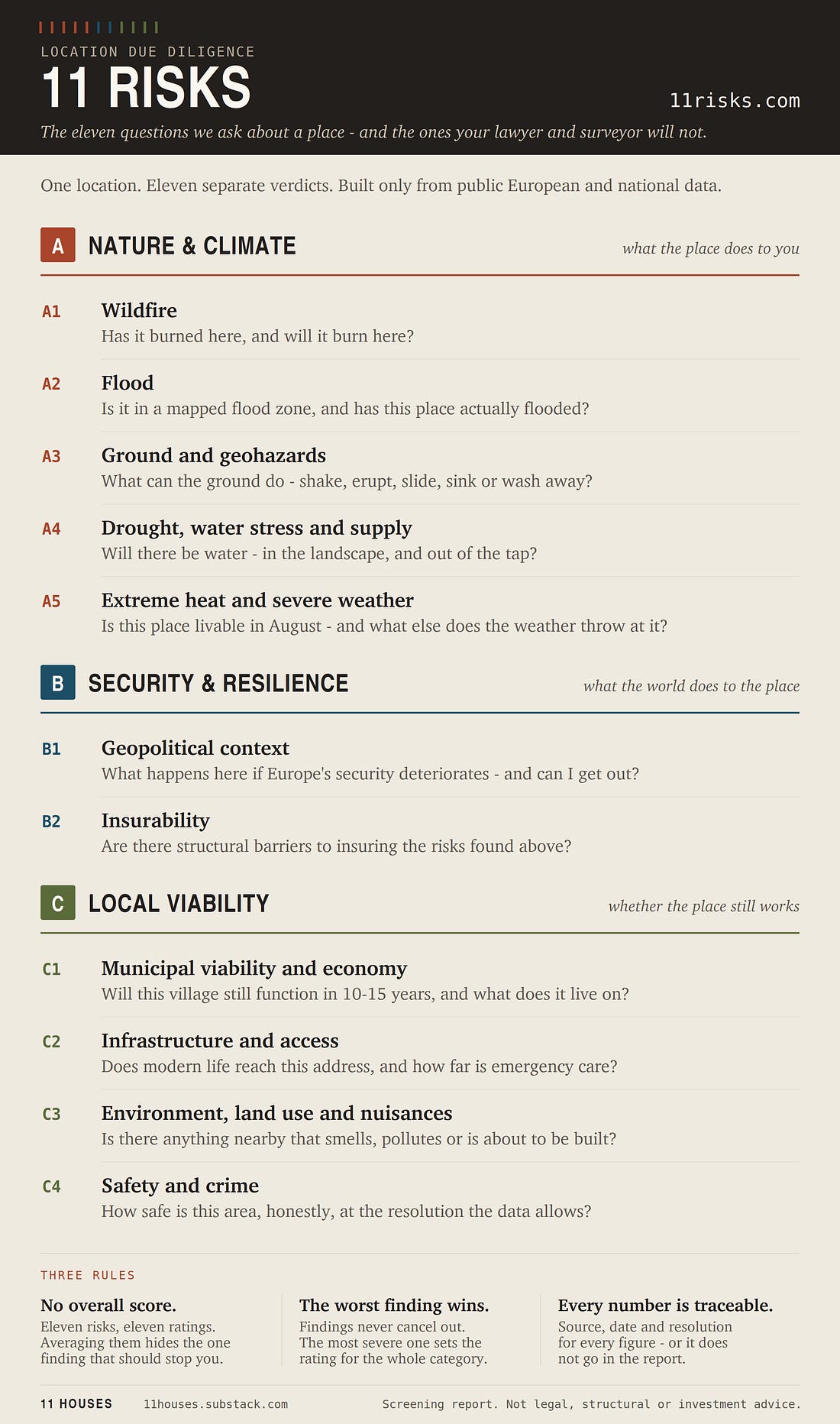 |
Three rules matter enough to state publicly:
There is no overall score. Ever. Eleven risks, eleven ratings. The moment you average them into a single grade you’ve invented precision that doesn’t exist and hidden the one thing that should have stopped the purchase. A location is not a number.
The worst finding wins. Inside a category, sub-findings never cancel each other out. A house ninety minutes from an emergency department is a red rating on infrastructure no matter how good the fibre is.
Every number carries three things: where it came from, when the data was captured, and at what spatial resolution. A figure without all three doesn’t go in the report. This matters more than it sounds - a lot of property “risk” content online is built on numbers with no scenario, no baseline and no date, which makes them unfalsifiable and therefore useless.
The data comes from public European and national sources: the European Forest Fire Information System and Copernicus for fire, the EU Floods Directive maps and national flood portals, the 2020 European Seismic Hazard Model, the European Ground Motion Service, the European Drought Observatory, EIOPA’s insurance protection gap dashboard, Eurostat etc.
What I did for this issue
Normally 11 Risks looks at one address. For this special I pointed it at whole regions instead - because a lot of you aren’t choosing between two houses yet, you’re choosing between two parts of Europe.
I screened around thirty candidate areas across Northern, Central, Eastern, Western and Southern Europe, then took the eleven where the evidence was strongest. An area made the list when two or more categories came out red at the same time, and those reds were structural - meaning they affect safety, cost, usability or resale value, and you can’t simply insure your way out of them.
That last clause is doing a lot of work, so let me show you what it excludes. The wildfire risk in the Var, in Provence, is genuinely severe. It didn’t make the list, because France has CatNat - a mandatory pooled catastrophe scheme that actually pays. The flood risk in the ravines west of Valencia is the worst in modern Spanish history, and it did make the list, but it ranks lower than places with smaller floods because Spain’s Consorcio de Compensación de Seguros paid out at scale. Meanwhile Greece has no mandatory catastrophe pool at all, and EIOPA puts residential flood insurance penetration there in the 0-25% band. Same water, very different outcome for the owner.
This is regional screening, not a verdict on any specific house. EU-wide data layers are coarse - drought at roughly 5 km, radon at 10 km, seismic hazard at regional grid. Within every region below there are villages that are demonstrably fine and villages that are demonstrably not. The purpose here is to tell you where to look harder, not to tell you never to go.
And I’ve given every area a counterpoint. For each one I’ve written what would have to be true for a sane person to buy there anyway - because for several of them there genuinely is an answer, and a list of eleven places with no other side to the story would be propaganda, not research.
The eleven
Campi Flegrei 🇮🇹
Po Delta 🇮🇹
Thessaly plain 🇬🇷...

Continue reading this post for free in the Substack app
| ||||||||||

